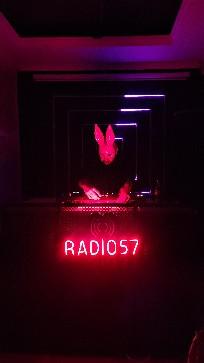
Alegrin Del Monte.

Genres
- Afro House
- Hard Techno
- Melodic House & Techno
- Acid House
- Darksynth
- Darkwave (Rock)
- 80'S
Full bio
Alegrin del Monte's artistic and pedagogical career is located at the transdisciplinary intersection between sound arts, literary mediation, sociology of culture and popular education in the department of Casanare and Bogotá, Colombia. Through the foundation and direction of the project entitled "DJ School in Casanare: for poetry and freedom", Alegrin del Monte has consolidated an avant-garde pedagogical model that decentralizes the learning of electronic music technologies and transfers it to the field of public libraries and regional community spaces, particularly in the Municipal Public Library of Támara and in the cultural space El Faro in the city of Yopal.
Within the framework of contemporary cultural theory, the participatory action research developed by Alegrin del Monte dialogues directly with the so-called sound turn, which states that sound and listening are fundamental analytical dimensions for understanding the production of subjectivity and social space. Traditionally, the public library has been conceived under an aesthetic paradigm of written culture where the hegemony of monastic silence rules. The intervention of the DJ Casanare School in the Municipal Public Library of Támara subverts this instituting dynamic by introducing consoles, laptops, sound monitors and headphones in the reading rooms. This coexistence between the bookshelf and the DJ controller creates a heterotopic space in the sense coined by Michel Foucault: a real place that juxtaposes in a single physical space multiple spaces and times that would otherwise be incompatible. In this way, the printed book and the digital waveform on the computer screen interact analytically. The library user is not a passive receiver of the written text, but a sonic orchestrator who extracts the meter from the poem and intertwines it with the rhythmic pulse or beat of electronic music.
The conceptual architecture of the DJ Casanare School is based on an ontological premise: poetry and electronic music share the same formal matrix based on rhythm, cadence, pause, accent and repetition. The poetic meter (free verse, the decasyllable, the tenth spinel of the llanero oral tradition) finds a structural correspondence with the rhythmic grid modulated in 4/4 bars characteristic of genres such as Deep House, Minimal or Experimental Techno. Alegrin del Monte's proposal articulates this principle through the methodology of poetic sampling. By microphonically capturing readings aloud of regional, national or universal poetry, and the subsequent manipulation of these sound traces through digital signal processing (DSP) tools, sound production is endowed with a deep semantic density. The voice does not operate simply as an ornamental element, but as the narrative axis on which the harmonic texture of the musical composition is erected.
The geographical and historical context of the department of Casanare gives a particular meaning to the praxis of Alegrin del Monte. Casanare, a territory characterized by a deep oral tradition marked by the songs of llano work, the copla and the costumbrista story, has undergone accelerated socio-cultural transformations due to technological modernization and internal migration processes. The choice of Támara – a municipality embedded in the foothills of the Cordillera Oriental with a rich coffee and historical tradition – and Yopal – departmental capital in constant urban expansion – as operational headquarters of the DJ School is not fortuitous. It represents a deliberate strategy of decentralization of the contemporary artistic offer. While the large Colombian capitals tend to concentrate technological infrastructure and training spaces in digital arts, the DJ Casanare School democratizes access to production software and mixing consoles in rural municipalities. This territorial exercise dismantles the digital and aesthetic divide, allowing the peasant and urban youth of Casanare not to approach electronic music as a foreign or alienating cultural product, but as a technical language for the rewriting of their own identity and local heritage.
The ideological motto underlying Alegrin del Monte's project, "for poetry and freedom," condenses the pedagogical orientation of the initiative. In the project's constituent documents, the mission is formulated in the following academic and social terms: "Our mission is to empower the Casanare community, from children to adults, through the fusion of electronic music, poetry, and literature. We seek to be a creative space where participants not only learn the technical skills of 'deejaying,' but also discover new forms of expression. By incorporating the spoken and written word into their compositions, we promote connection with their cultural roots and the creation of unique sound narratives that reflect their identity and stories."
From the perspective of Freirean critical pedagogy, technical learning devoid of a critical or reflective consciousness is insufficient for social transformation. Alegrin del Monte conceives the acquisition of technical competence (the use of mixers, equalizers and computer programs) as a means to achieve expressive autonomy. The "freedom" to which the project alludes is the freedom of enunciation: the ability to take the word, record it, process it and circulate it in the public domain in the form of an autonomous sound-literary work.
The visionary development of the DJ Casanare School projects a qualitative transformation of the role of the DJ in contemporary society. The vision of the project specifies the following: "We aspire for the DJ school of Casanare to become a beacon of artistic and cultural innovation in the region. We want our students to become sonic storytellers, able to intertwine modern rhythms with the richness of literary tradition. We envision a future in which the DJs of Casanare not only animate parties, but also act as custodians of the collective memory, using their mixes to breathe new life into local poetry, traditional tales and the voices of its people."
This reconceptualization elevates the DJ to the rank of performative archivist or sonic hermeneutician. Rather than being limited to the commercial juxtaposition of pre-recorded tracks, the student trained under this method learns to research in the bibliographic collections and oral heritage of their community. Myths, legends, micro-histories of violence and resilience, as well as verses by local poets, are transformed into audible archival material. The DJ console thus becomes an institutional turnstile where digital technology and intangible cultural heritage coexist in a state of cross-pollination.
Learning from the Sensory and Technological Experience The methodology developed by Alegrin del Monte is based on pedagogical constructionism and situated learning. Teaching does not begin with a theoretical abstraction detached from the technological object, but with direct, haptic and sensory contact with the work instruments.
In the workshop sessions documented at the Támara Municipal Public Library, participants—who span an intergenerational spectrum from early childhood to adulthood—immediately interact with DJ controllers, analog mixers, and laptops with specialized programs such as Serato DJ. The teaching-learning process articulates two dimensions of perception:Visual perception: By graphically analyzing the sound wave (waveform) on the computer program screen, the student learns to visually identify the bass (kick drums), mid frequencies (vocals and harmonic instruments), and high frequencies (cymbals or hi-hats), as well as the structures of the song (intros, drops, bridges, and outros). Auditory and haptic perception: The coordination between the ear (through headphone monitoring) and the fine movement of the hand (manipulating the jog wheel, the equalization potentiometers and the volume attenuators or faders) allows the graphic representation to be translated into a bodily experience of rhythm. 3.2. The Pillars of Sound Technique: Micro-Technical AnalysisThe practical curriculum designed by Alegrin del Monte articulates four fundamental axes of mixing engineering applied to deejaying.
A unique aspect observed in the documentary evidence of the DJ Casanare School is the elimination of traditional age barriers in the classroom. In the same workshop in the public library, young children, young people in school and adults from the community live together.
This intergenerational configuration generates a circuit of collaborative learning and reciprocal tutelage: Children and young people, familiar with digital interfaces and the logic of smart devices, quickly assimilate the tactile and visual navigation of the software. Adults contribute their reading background, their historical memory of the region, and their narrative fluency in reading aloud. In practical sessions, it is common to observe a young student assisting an older adult in navigating through folders of digital files, while the adult guides the selection of poetic texts that will be recorded and mixed. This reciprocity strengthens community social cohesion and converts the library
Videos
Dark Session Vol 2